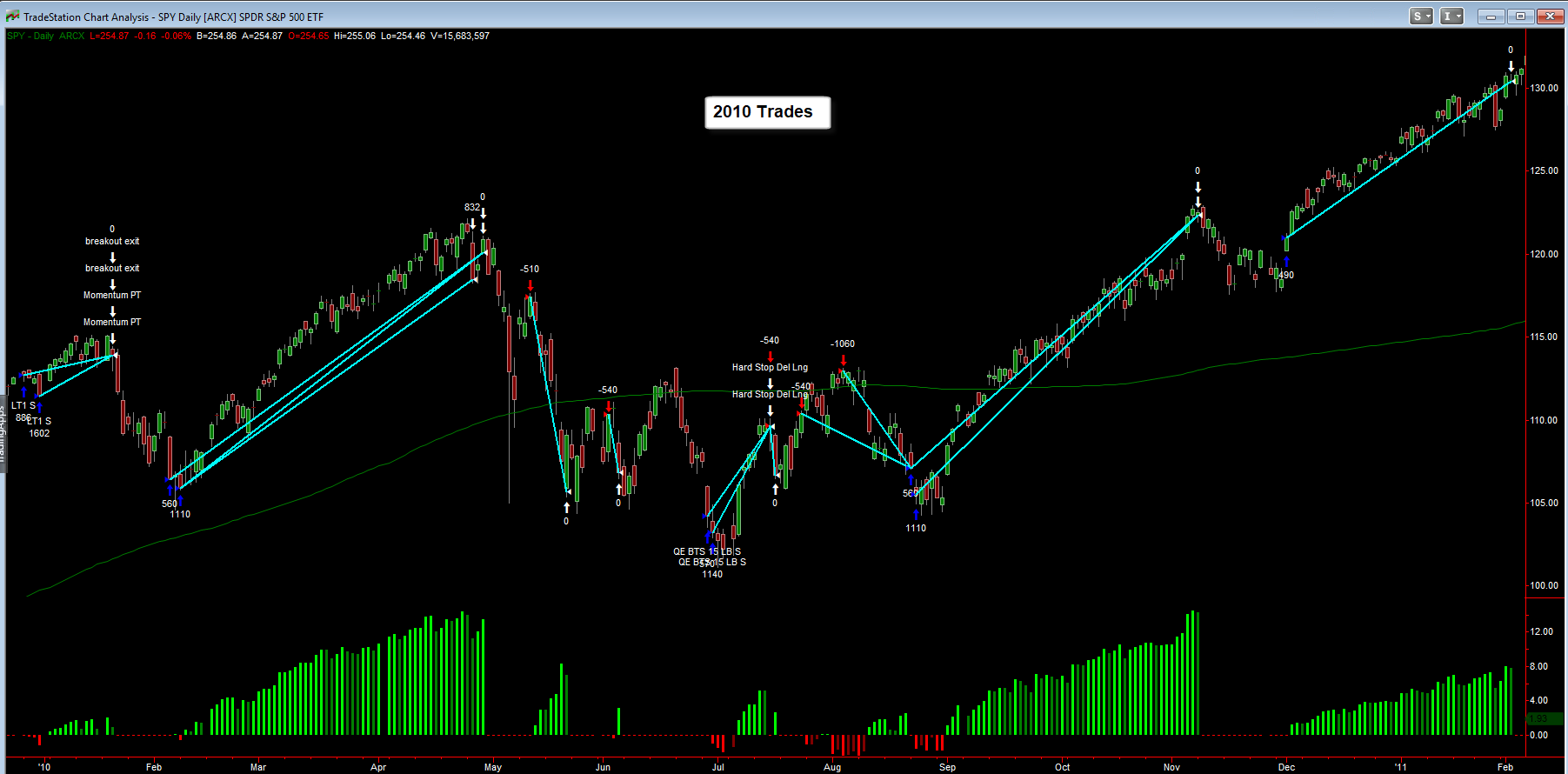
Professional Level SPY Swing System

Professional Level SPY Swing Trade System!

After a long time in development, we are happy to finally introduce the Professional Level SPY Swing Trade System.  SPY is the 1X ETF for the S&P 500, which was the very first ETF to begin trading in the US, and was released way back in 1993.  Our system trades the SPY as the "proxy" for the S&P 500 Index.  

Currently Breakpoint Trades has a long term S&P 500 system for managing 401K plans on the website located in the 'Long Term Tools' section called 'Long Term SPX system from 1961'.  While the system does a far better job than the 'buy and hold forever' mantra that your standard Stock Broker or Investment Advisor advises you to do, that system only does about 1 trade a year on average and therefore is akin to watching paint dry and is not something that a trader would be interested in. Our goal therefore was to develop a system for swing traders that does about 12 - 20 trades a year and holds for days and weeks at a time, NO day trades; this goal has finally been achieved!

A True End Of Day Swing System:

This system is a "true" swing system with an average hold time of about 12 trading days (not counting weekends and market holidays), however that is just an average as some trades last as long as 2 - 3 months while others last as little as 3 - 5 days. Each new trade is entered at the end of the day (no intra-day day trades), which makes it ideal for those of you who work day jobs and cannot follow the market all day long!  All new trades (coming from a 100% Cash position) (both Longs and Shorts) are entered at the market close, however, if the system has an existing long or short position, long positions are exited on the market open the next day, while short positions are exited on the market close that same day (because statistics prove this to be the best combination). The beauty of this system is that during the day, you can focus on your day job instead of the market; just make sure you are available during the market open and close to act on the signals from the system. So that means you only have to look at the market a maximum of twice a day! 

A few key statistics:

1. 91% profitable trades going back to 1995 for the Single Entry System, 96.5% profitable for the "Multi Entry" system.

2. Consistent double digit gains each year in every market condition: Bull Market, Bear Market, or sideways Choppy market, doesn't matter!

3. Average of 35.5% per year, non-compounded gains, no losing years!

4. Compounding Returns: Starting with $100K, this would have turned into > $17.5 Million! or 175 times the original principal! 

5a. Single Entry System: Profit factor of 27, this means that the system only lost about -$1000 for every $27,000 that it made, or -$3700 for every $100,000 that it made! 

5b. Multi Entry System: Profit factor is 37, this means that the system only lost $1000 for every $37,000 made, or -$2700 for every $100,000 made!

6. 42 consecutive winning trades and only 2 maximum losing trades in a row!

7. Largest losing trade was -3.36%, and that was an outlier because the next 3 largest trades out of 260 trades were -3.1%, -2.3%, -2.2, and the average losing trade being only about 1%.  Note, for the Multi Entry system, the largest losing trade was only -1.3%

8. An average of 17 trades a year...truly a swing trade system.

9. The average time in a trade is about 12 days, however that's just an average because some trades last as little as 3 - 5 days, while some trades last as long as 2 - 3 months.

10. Consistent double digit gains each year in every market condition: Bull Market, Bear Market, or sideways choppy market. 

You are getting access to a "Professional Level" System:

The SPY system that you are subscribing to is a professional level system that you have access to for pennies on the dollar. We were advised NOT to offer this system at Breakpoint Trades by some of my friends in the hedge fund business who advised us to only make it available to professional traders and hedge funds. However, it has always been a goal of ours to give members of BPT access to a trading system like this which trades the S&P 500 and does 12 - 20 trades a year!

Systems of this caliber are never for sale to the general public and generally only professional hedge funds and large brokerage firms like Goldman Sachs have access to them (We know because we've seen them).  We considered only offering this system to professional traders and hedge funds, however it has always been a goal of mine to give members of Breakpoint Trades access to a pro level system like this which helps to level the playing field for the "retail" investor/trader!  Now you have access to a professional system without being a professional!  I hope you enjoy it and profit from it!

The System code and parameters are not for sale:

We are not selling the system code or the parameters to the system! If we did it would be very expensive, well over $100K or more. What you are subscribing to are the signals (buy and sell signals) to the system.

How will I be notified when the System issues Trade Signals?

All Subscribers to this system will be notified via email as well as SMS text messages (if you have this service set up for your cell phone). As we stated above, all new trades/signals are entered at the close of the day by the system, therefore we will send out an official new trade notification 5 - 10 min before the market closes (4PM EST) so that you have time to enter the trade. However we may also send out a preliminary trade notification earlier in the day such as 1 hr before the market closes so that you can be ready and get back to the computer, if you are out and about running errands for example. Of course the SMS service will be a nice benefit for alerting you by cell phone when you are not at your computer. However, since the market can change quite a bit during the last hour, the preliminary signal may not always translate into a true buy/sell signal at the close, that's why you MUST wait until the final notification from us (the last 10 min or so before the close) before taking the trade. The statistics to the system are based on end of day closing prices; therefore per the system you would enter new trades (longs or shorts) near the close such as the last min of the day.  However longs and shorts are handled differently when the system is exiting existing positions, check the FAQ for more details. 

Is this System curve fitted?

We don't think so, just look at the facts: this is not a system that has been optimized over only 6 months or a year; the system goes back to 1995 and has worked across all market conditions and bull/bear markets, thus we think it is very robust:

- The secular bull market of the 1990s

- The bear market from 2000 - late 2002

- The bull market from 2003 - 2007

- The horrific bear market from late 2007 - Mar 2009

- The current bull market from Mar 2009 - present

Real Money Behind The System:

As you may have seen, the system statistics/reports are based with each trade being $100,000.  I did this for simplicity so that the net gain/loss dollar amounts that are shown in the Tradestation Reports are also equal to the percent net gain/loss.  For example, a system trade makes $10K, this means that the trade made 10%. 

However that said, since each system trade is based off $100,000, I've also set aside $250,000 of my personal money to trade in real time at my Interactive Brokers account for the multi entry system, I also plan to use 50% compounding.  I plan to publish my results along with the systems theoretical results!


Excerpt from the FAQ regarding how trades are entered and exited for the SPY Swing Trading System

Q:  When are trades entered?
A:  All 'new' trades are entered at the close of the day per the statistics, which makes this a true end of day swing system.

Q:  When are trades exited?
A:  While all new trades are entered at the close of the day; longs and shorts are exited differently:

Longs - are exited on the open of the next day and not the close! Fortunately the sell condition is generated at the close of the previous day, therefore you will have 1 day notification to exit your Long position.
Shorts - are exited at the close of the same day that the sell signal is generated, unlike the Longs which are exited the next day on the open.

Q:  Why are longs and shorts exited differently? Why not just have everything exit on the market close to make the system simpler?
A:  Yes the system would still be VERY profitable by having all the trades exit at the end of day like the entries. However published statistics on the SPY (below) show that it's much more profitable to buy Longs at the close and Sell them on the open.


Check out the third party statistics below from Bespoke, which supports the rationale behind our exit rules for our SPY Swing System (Longs exit on the open of the following day while Shorts exit on the close of the same day)

Statistcs show that the majority of gains occur overnight vs during the trading day!  The charts below are from Bespoke.com

Chart 1:

Shows you the statistics of buying SPY at the close and selling the next day on the open. This strategy of holding overnight resulted in a 378% gain over the last 17 years from 1993 until April 2010! This chart also shows us that most of the gains for the market have occurred overnight vs during the trading day.

Chart 2:

Shows you the result of buying the SPY on the open and selling at the close. Notice that from 1993 - Apr 2010, this would have resulted in a net loss of -38.6%! This is why our SPY system does not exit long trades on the close!

Chart 3:

Shows you three data lines from charts 1 and 2, as well as just simple buy and hold. What is really amazing here is that if you had bought the SPY in 1993 and held until April 2010, it would have only resulted in a net gain of 193% in 17 years! However, notice that simply buying the SPY every day at the close and selling it the next day on the open resulted in more than double the gains of 378%!! Of course, you can see the dismal results of buying on the open and selling on the close the same day.

This independent 3rd party research helps to validate our system exit rules

z_-_eodstatsclosetoopen_513


z_-_eodstatsopentoclose_518


z_-_eodstatsbuyandholdcompare_512


Frequently Asked Questions:

Note: Please take the time to thoroughly read the FAQ questions and answers below, I took a lot of time to make them as detailed as possible in order to cover all bases. This is a MUST READ!


Q: Why did you build a system for the SPY ETF?

A: Because SPY is the ETF for the S&P 500 and it is very liquid. Also many of our members try to trade the 'market' via the S&P 500 through ES futures or ETF's like SSO, SDS, but trading the indexes can be extremely difficult. I personally think that it's more difficult trading the market indexes versus trading individual stocks. Also systems take the emotion out of trading/investing (which can be the main pitfall for many traders) and while we already have a system for trading gold stocks (GDX swing system), members have been clamoring for a system that trades the general stock market i.e. S&P 500!


Q: What are the parameters to the system, how are the trades generated?

A: That's a trade secret, and it is closely guarded to insure the integrity of the system. We are not selling the system code, only the buy/sell signals. However, generally speaking the system uses the principle of 'mean reversion' more so then "momentum Trading", though it will ride strong trends when it is in a trade.  


Q: Can I purchase the system code?

A: We are not selling the system code, only the buy/sell signals. Of course everything has its price, but be prepared to offer a huge sum for us to even consider it!


Q: Can you at least tell me the general concept to the system, what kind of trades does it do, etc?

A: The SPY system does not chase trades i.e. it does not chase breakouts and short breakdowns. The system is a 'regression to the mean' type of system. It attempts to short overbought rallies and buy oversold conditions in statistically optimal conditions. The system can also tell if the market is in a bull or bear market; for example, in bear markets the majority of the trades will be Shorts (shorting overbought rallies), the system will still do Longs but the majority of the trades will be shorts. And in bull markets, the majority of the trades will be longs i.e. buying pullbacks in uptrends, though it will take a short from time to time. The system adapts to market conditions i.e. it does short term trades in choppy markets, and holds trades for long periods of time in trending markets in order to catch the trend. Also this system incorporates a lot of things that I've learned as a trader over the years as well as tips and tricks that you see us use at Breakpoint Trades! A lot of care and thought was put into this system to make it as robust as possible.


Q: When are trades entered?
A: All 'new' trades are entered at the close of the day per the statistics, which makes this a true end of day swing system.

Q: When are trades exited?
A: While all new trades are entered at the close of the day; exiting longs and shorts is different:

Longs - are exited on the open and not the close! Fortunately the sell condition is generated at the close of the previous day, therefore you will have 1 day notification to exit your Long position.
Shorts - are exited at the close of the same day that the sell signal is generated, unlike the Longs which exit the next day on the open.

Q: Why are longs and shorts exited differently? Why not just have everything exit on the market close to make the system simpler?
A: Yes the system would still be VERY profitable by having all the trades exit at the end of day like the entries. However prior published statistics on the SPY show that it's much more profitable to buy Longs at the close and Sell them on the open.

See the 'Entries/Exits' tab for an overview of the exit statistics, very compelling!


Q: I see that you have a Single Entry and a Multi Entry system, I'm confused?
A: The Single and Multi Entry system are the same system; the difference is that the Single Entry system is just what it sounds like, there is only one entry and one exit.  The Multi Entry system can have a total of 4 entries, and will attempt to scale-in or average into a position when price goes against the first entry.  There are advantages and disadvantages to both, please see the 'Multi Entry' tab overview for more details.


Q: How are trades entered for the Multi Entry system?
A: Please see the 'Multi Entry' tab for more details and examples. However the "scaled-in" or Multi Entry version to the Mechanical SPY Swing system will attempt to scale-in or average into a position when price goes against the first entry. The "scaled in" system attempts to scale into trades in 4 percentage parts, 40%, 20%, 20%, 20% for a total of 100% if the system calls for 4 scale trades. The majority of the trades are either single entry at 40% or double entry at 60% total (40% + 20%) because the system is already very adept at entering trades. This means that in most cases, you will not be fully invested in a trade using the 'Multi-Entry system'. It is up to you to decide which system to use, there are benefits and drawbacks to both.


Q: Is the system always in the market, always in a trade?

A: No, the system is not always in a trade, in fact it's only in the market about 48% of the time! Most of the time when the system exits a trade, it will go 'Flat' for a while until it sees another entry. This is actually a good thing because it frees up your money to do other trades! In addition, successful traders know that Cash is a position! Risk management is the primary objective here. The system is only in the market when it sees a statistical reason to be, it does not force trades.


Q: How many trades does the system typically do in a year?
A: On average the system does about 17 trades a year - see the Statistics tabs for the Single Entry and Multi Entry systems.

Q: What are the statistics of the system? Profit Factor, % winning trades, etc?
A: Please see the 'System Statistics tabs for the Single Entry and Multi Entry systems for more detail; however the system has been about 91% profitable with a profit factor greater then 27, which is insane. The Multi Entry system has even better statistics with a profit factor of 37 and 96% winning trades.

Q: It's been just over a month since the system closed out its last trade, is this normal? Why hasn't there been a new trade?
A: Yes this is perfectly normal; please review the system statistics in detail as well as the example charts. While this is generally rare, there have been a few instances where the system was out or out of the market for 1 - 2 months at a time.


Q: Is this system curve fitted, how do I know that it won't just stop working?

A: Well first off, there are no guarantees in life; especially trading, thus just like any system it could stop working at any time (read our disclaimer). However that being said, a lot of care went into this system and it incorporates things we personally use in our own trading vs a bunch of arbitrary variables and indicators. Also, the system has worked in all market conditions, bull and bear markets:
For example,
this is not a system that has been optimized over only 6 months or a year, this system was optimized back to 1995! Also this system has no losing years and has worked in all market conditions: For example, - The Secular bull market of the 90's and the Internet Tech Bubble of the late 90's

- the Tech Bubble crash and bear market of 2000 - late 2002
- the cyclical bull market from late 2002 - Nov 2007
- the vicious bear market from Nov 2007 - Mar 2009
- and of course the current cyclical bull market Mar 2009 - Present.


Q: How will I be notified of when the System issues Trades/Signals?
A: All subscribers to this system will be notified via email as well as SMS text message (if you have this service set up for your cell phone) to check the Professional Level SPY Swing System portion of the BreakpointTrades.com website.  The system trades/signals will be placed on the "Current Trade" tab within that portion of the website.  The system signals WILL NOT be emailed or sent via SMS text.  The reason is that it is easier for us to control any potential unauthorized dissemination of the system signals by requiring subsribers to check the website.  

As we stated above, all new trades/signals are entered at the close of the day by the system, therefore

On the "Current Trade" tab, the system trade/signal will also contain information regarding what price the SPY needs to close at in order to satisfy the conditions for entering the trade.  For example, the system/trade signal may say: "Indications are that the SPY Swing System may go long today at the close.  SPY needs to close below $131.00 in order to initiate a long entry."  The statistics to the system are based on end of day closing prices; therefore per the system you would enter new trades (longs or shorts, coming from 100% cash position) near the close such as the last min of the day.  However longs and shorts are handled differently when the syste is exiting existing positions, check the Entries/Exits tab for more details.  If the market (via the SPY) does indeed close at a price that satisfies the price conditions for the system to initiate a trade, the trade will be posted on the "Current Trade" tab.   

Q: I see that the system did a trade today; however I never got an email?
A: Since our system sends an email to all email addresses on file automatically, the problem is likely on your end; first off please check your spam filter in your email program, chances are our BPT email was flagged as spam. If you can't figure out the problem, we suggest changing your email address on file with us. We've found that Gmail works fantastic and recommend this free email service!


Q: My system trades do not exactly match the same prices that are reported in the trade statistics?

A: That's to be expected; the system reports the trade entries at the exact closing price for all new trades, and for closed out short positions, which are also exited on the close; while the system reports the exact opening price for long trades which are exited on the next day's open. However most of the time you won't be able to enter the system trade exactly at the close of the day, 10 seconds or a minute before the close on average. This should only cause a very slight deviation between your trade entries and the system entries and have only a negligible effect over time on performance - in fact some times you will get a better price then the system, while other times the system will beat you by a few cents, hence it ends up being a wash.


Q: I received the email that the system would be entering a trade at the close, however I was out running errands and was unable to get back to my computer or trading account before the market close to enter the trade, what should I do?

A: Well the good thing is that the SPY ETF is very liquid and you can probably enter the trade after hours without much problem. After hrs trading is open until 8 pm EST. Also the average time that the system is in a trade is about 12 days, therefore it's not critical if you miss a system trade by a slight amount like it would be if you were trading a short term day trade system. You could probably also enter the trade in the morning if the price doesn't gap too much, and of course you can enter the trade if the price falls below the entry of the system.


Q: I've just subscribed to the SPY Swing System, however the system is already in a trade, should I enter the trade now?

A: In most cases, the answer would be NO. In order to take advantage of a mechanical system and allow the statistics to play out, you need to take all the trades per the system! If you enter a system trade days or weeks after the entry, you are on your own. The only time that I would advocate entering system trades after the fact is if you can get a better 'entry' than the system entry. For example, if the system entered a Long trade at $100, and now the current price is now below $100, and you missed the original entry, then you can enter the trade even if you missed the original entry.


Q: The system trades the SPY S&P 500 ETF, however can I substitute leveraged ETF's like SSO for the long trades and SDS for the short trades, or can I trade ES futures in place of the SPY ETF?

A: Yes you can since those instruments should follow the SPY since they are all following the S&P 500. However that being said, realize that for leveraged instruments like the 2X or 3X ETF's, while your winners will theoretically be 2 or 3 times larger, your losses will also be 2 or 3 times larger! For example, currently the largest losing trading for the system is -3.36%, however it would be -7.2% using SSO and SDS, and -10.1% using the 3X ETF's.  In addition, leveraged instruments can degrade some over time.  Therefore make sure that your psychology can handle this!


Q: I would like to trade this system in my 401K or IRA retirement account, however I cannot short SPY in my account, can I still play the system?

A: Yes of course, you have a lot of choices to choose from:
1. The easiest thing to do would be to buy SH, which is the -1X inverse ETF to the SPY in place of shorting the SPY. You could also buy SSO (2X long) and SDS (2X short) ETF's, however realize that these are 2X leverage ETF's thus while your gains will be double, so will our losses and draw downs.
2. You could also choose to take ONLY the long trades. Most of the trades in the system are long trades and the system is about 91.6% profitable (for the Signal Entry system) and 97% profitable (for the Multi Entry sytsem) taking only the long trades, which is very impressive.


Q: I don't trust the current system trade buy/sell signal, should I not take this trade?

A: That's up to you; however you have to be extremely careful about second guessing system trades. The whole purpose of a mechanical system is to take away the decisions and the emotion that makes trading so difficult for most people, therefore when you second guess system trades, you are defeating the whole purpose of a mechanical system! Also, you may be right and you may not be, I've personally found that at best about 50% of the time you guess right. Plus this can lead to the emotional condition that I call 'System Sickness' where you second guess a trade and end up missing a good trade, then you take the next trade and it's a bad trade, so you skip the next trade and it's a good one, i.e. a vicious cycle. What ends up happening in most cases is that you under-perform the system!! Remember that you need to play the system "as is" in order to match the statistics, not "cherry pick" and choose the trades!


Q: How much money should I invest in the system trades?

A: That's up to you and you have to make your own trading decisions based on your objectives and personal risk/tolerance and we are not investment advisors; however we suggest using proper money management. What we mean by this is, don't put 100% of your money into the system trades or leverage up your account using margin for the system trades.  Instead the system trades should probably not total more than 5% - 10% of your trading portfolio!  Again it's no different when trading normal stocks, diversify your holdings, don't place all of your eggs into one basket!


Q: I've noticed per the system statistics you show, that all the trades are the same dollar amount of $100K. Should I also put the same amount of money into the trades, or can I vary this?

A: This is up to you; however you should have a plan when you trade the system!  We suggest in order to match the system statistics that you should be consistent: Either keep all your trades the same dollar amount like the system, or you can compound your trades by taking a set percentage of your profits and reinvesting them into each trade. For example, you may decide to compound 10% or 25%, or 50% of your profits back into the system. However, consistency is the "key" here, do NOT change "willy nilly" i.e. where you are constantly changing your dollar amount, i.e. keep it consistent!

Signups closed until further notice

If you you have already purchased the SPY system and would like to manage SMS settings please try logging in again.

Sign up for SPY Waiting List

We will eventually be opening the SPY System back up, signup below to receive an update when we open it back up to the public.

Please note: You Must have a Membership at Breakpoint Trades before you can subscribe to this system

The goal of this system was to benefit BPT members and not cannibalize the BPT membership by having members cancel their regular BPT membership and subscribing only to the SPY Swing System.  Thus, membership to Breakpoint Trades is required in order to subscribe to this system!

Membership Details:

Also there are absolutely no refunds for a membership to the system.  This is a professional level system that you are getting access to for pennies on the dollar.  Once you subscribe to it and are charged, there will be no refunds.  We do this because we do not want people abusing the privilege of using this great system, and we also only want members who are serious.

Membership will be Limited

Also in order to keep the integrity of the system intact, membership to this system will be limited. 

Grounds for revoking one's membership:

The Trade signals are for personal use only, and are not to be shared with others.  Membership will be revoked and not refunded if we catch anyone re-distributing the buy/sell signals.


Please Watch this **VIDEO**

Please Note!  You must first sign up for a SPY membership before you can set up your SMS SPY membership/settings!  Once you have subscribed to the SPY system, then you can set up your free SMS text message alerts!

Also, we currently have an SMS servive for the website, which sends out alerts from our watchlist and trade ideas. If you already have this SMS membership, then you don't need to do anything! You are already set to receive messages!

However we are including SMS text messages for the SPY system for free for subscribers to the SPY system.  Please note, this ONLY includes messages to the SPY system!  If you desire message alerts for our trade ideas and the GDX system, then you will still need to buy it separately. 

If you cannot receive an SMS message to your phone, dont' fret because all the SPY system messages will be sent to you via Email!  Therefore you will still receive the messages even if you cannot set up the SMS service. The SMS service is simply a secondary alert system to the Primary Email alert system.


SMS FAQ

SMS Text Messages to your phone is included free with a membership to the SPY system!

This is very useful feature because if you away from the computer running errands, as long as you have a cell phone with one of the carrier plans that we support which current is 16 different carriers, we will send you an SMS text message to your phone to alert you!  However the message will also go to your email by defult, therefore even if you are unable to get the SMS text message to work for you, you will still receive an email!

Note: This service only includes messages from the SPY system, it does not include text messages from the watchlist and trade ideas list, if you would like those, you will need to sign up for it separately.


Sign up process:

When you sign up, you can choose to receive either SMS text messages on your cell phone or emails or both.  However in order to receive SMS Text messages to your phone, you must first verify that your phone is capable of receiving messages from BPT. The system will send a 'test' text message to your phone with a secret key, you must then input the key into the site in order to verify that SMS messages are being received.  However you can choose to only receive emails if you wish, or you can receive both SMS and emails, or only SMS, whatever you choose.

SMS carriers:
Initially we are only supporting AT&T, Sprint, T-Mobile, Verizon,
Cricket, Telus, O2, Bell, Rogers Wireless. Virgin and others...16 in all.  However we realize that there are many other carriers that you would like to use, therefore we have provided a request form so that you can request new carriers from; you will see this on the right hand side of the sign up form in the blue box 'Request a New Carrier'. A member of our support staff will respond to you ASAP and schedule a time to test the system.

SMS and/or Email:

Remember that you can choose what you want to receive, SMS Text, Emails, or Both.  We've included an option for you to choose one or the other, or you can turn them off for a certain time - for example if you are in a meeting or go on vacation, then obviously you would want to disable these alerts during that time frame - we've provided this function as well; you can of course turn them back on when you choose.  You can do this from your 'My Account' Page on the website.


Please note: You must first set up your phone number through the system and do a test message and code, so that the system can verify that you are able to receive text messages from us.

Overview: Please note that we have two versions of the same SPY system; a single and multi-entry version.  The Single Entry system is just like it sounds, there is only one entry and one exit i.e. 100% of the position is taken on the first trade.  The statistics below are for the 'Single Entry' version of the system.  


A few key statistics for the Single Entry System:

1. 91% profitable trades going back to 1995 for the Single Entry System.  96.5% profitable for the "Multi Entry" system.

2. Consistent double digit gains each year in every market condition: Bull Market, Bear Market, or sideways choppy market, doesn't matter.

3.  Average of 35.5% per year, non-compounded gains, no losing years!

4. Compounding Returns: Starting with $100K, this would have turned into > $17.5 Million!  or 175 times the original principal!  

5. Single Entry System: Profit Factor of 27, this means that the system only lost about -$1000 for every $27,000 it made, or -$3700 for every $100,000 made! 
The Multi Entry System: Profit factor is 37, this means that the system only lost $1000 for ever $37,000 made, or -$2700 for every $100,000 made.

6. 42 consecutive winning trades and only 2 maximum losing trades in row!

7. Largest losing trade was -3.36% with the average losing trade being only about 1%.  Note, for the Multi Entry system, the largest losing trade was only -1.3%

8. An average of 17 trades a year...truly a swing trade system. 259 total trades in 16 plus years.

9. The average time in a trade is about 12 days, however that's just an average because some trades last as little as 3 - 5 days, while some trades last as long as 2 - 3 months.

10. Consistent double digit gains each year in every market condition: Bull Market, Bear Market, or sideways choppy market.  


The images below show the trade statistics for the 'Single Entry System'. Please note: The statistics are computed with each trade as $100,000.  We do this in order to keep it simple and makes the math easy because it causes the percent gain and $dollar amounts to be equal.  For example, if trade shows a gain of $10,000, that means that it gained 10%  

I will update these from time to time, however if you wish to see a 'Complete' MHTLM trade report, please click on the link:


stats_-_single_entry1_1216


stats_-_single_entrytime_646


i_-_single_entry_curve_750

 i_-_single_entry_yearly_594


 stats_-_single_entry_monthly_1091


 ..

Compounding Effects (see the images below)

The following Statistics below show the results of compounding your profits back into each new trade and the dramatic effect that this has on the net gains over the life of the system.  Remember that previous trade statistics show the result of each trade as the same $dollar amount, no matter how much money was made over time, which we feel is kind of unrealistic.  

Below we show the results for compounding 100% of your profits back into each new trade (which may be a bit unrealistic in the real world but nice to show), however we also show the results of compounding 50% and 25% of your profits back into each new trade, which is very realistic in a real world trade setting as it's not so aggressive.  
 

Results: Starting with $100K as the initial investment

- 100% of your profits compounded back into each trade turned into $17.6 million! 
Remember since you started with $100K, this is about 175 times return on your money in just over 16 years from 1995 - April 2011!

- 50% of your profits compounded back into each new trade turned into over $3.7 million!  Starting with $100K in 1995, that is over 37 times your money in just a little over 16 years!

- 25% of your profits compounded back into each new trade turned into about $1.4 million! That's about 12 times your money in just over 16 years!


- 100% of your profits compounded back into each trade turned into $17.6 million! 
Remember since you started with $100K, this is about 175 times return on your money in just over 16 years from 1995 - April 2011!


stats_-_single_entry_compounded100_curve_748

stats_-_single_entry_compounded100_main_662


- 50% of your profits compounded back into each new trade turned into over $3.7 million!  Starting with $100K in 1995, that is over 37 times your money in just a little over 16 years!


stats_-_single_entry_compounded50_curve_754


stats_-_single_entry_compounded50_main_653


- 25% of your profits compounded back into each new trade turned into about $1.4 million! That's about 12 times your money in just over 16 years!


stats_-_single_entry_compounded25_curve_748

stats_-_single_entry_compounded25_main_653


Single Entry Trade Examples!

Below are trade examples of the system from the system, as you can see, the system has played the market like a fiddle. 
It does a lot of quick trades, but also catches many runners and trending trades! We did not include every trade to
the system below, but we did include the majority of them and a good sampling.  The system is not perfect, no 
system is, but it's been damn good!  Of course the key will be how it performs going forward, there are no
guarantees, however we think the fact that since the system has worked in all types of market conditions (bull and
bear markets, choppy conditions, trending conditions), that it has a very good shot to continue doing well years
from now.

                                                    (Click on the charts below to see the full size!!)

 Example Trades from Feb 2010 - April 2011

trade_-_single_recent_bar_993_01


Example Trades from Late Feb 2009 - Jan 2010

spy_-_2009_1366


Example Trades from July 2008 - May 2009

spy_-_2008_last_1417


Example Trades from Nov 2007 - Sept 2008

spy_-_2009_early_1414


Example Trades from Jan 2004 - Nov 2004

spy_-_jan_2004_-_nov_2004_1269�


Example Trades from March 2003 - Dec 2003

spy_-_mar_2003_-_dec_2003_1369_01


Example Trades from May 2002 - Dec 2002

spy_-_2002_-_dec_2002_1341


Example Trades from Nov 2000 - July 2001

spy_-_nov_2000_-_july_2001_1344


Example Trades from Oct 1996 - Aug 1997

spy_-_oct_1996_-_aug_1997_black_1379


Example Trades from Dec 1995 - Oct 1996

single_early_1996_bar_1006


Example Trades from Jan 1995 - Nov 1995

spy_-_jan_1995_-_nov_1995_black_1258

Please subscribe to the SPY system in order to see the current trades. If you are already currently subscribed please load the members home in order to refresh your login.
# Type Date Price Shares Gross P/L Cum Net Profit % Profit

These trades are the actual system trades since August, where as Trade History reflects our updated system.

# Type Date Price Shares Gross P/L Cum Net Profit % Profit
Please subscribe to the SPY system in order to see the current trades. If you are already currently subscribed please load the members home in order to refresh your login.

In addition to the 'single entry system', We also have a "scaled-in" or Mult Entry version to the Mechanical SPY Swing system that will attempt to scale-in or average into a position when price goes against the first entry.  The "Multi Entry" system attempts to scale into trades for better prices for a maximum of 4 percentage parts, 40%, 20%, 20%, 20% for a total of 100% if the system calls for 4 scale-ins during a trade. The majority of the trades are either single entry at 40% or double entry at 60% total (40% + 20%) because the system is already very adept at entering trades.

There are many benefits scaling into a trade as a few drawbacks, however the benefits outweigh the drawbacks.

Benefits to a 'scaled in' system:

1. While the system does an amazing job at entering trades, it does enter early from time to time where price will go against it, therefore you get the benefit of averaging into many of the trades at better prices.

2. The percentage of winning trades goes up because the "few losing trades" are now winners because the system was able to average in at better prices.  The single entry system wins about 90 - 91% of the time, whereas the Multi Entry version wins about 96 - 97% of the time, which is amazing.  Also the scale-ins help to "smooth" the Equity Curve.

3. If both systems are traded with $100K; the average losing trade drops from about -1.2K to -0.35K, while the largest losing trade drops from -3.4K to -1.3K.  Also the draw down is a lot less for the Multi Entry version for obvious reasons; for example the largest draw down for the Single Entry system is -10K, but is only -4K for the Multi Entry system.  The profit factor also increases into the high 30's which is just insanely high.  

4. Also from a psychological standpoint, We think that a "scaled in" system is easier to trade because you are not fully invested on the first entries, and when the trade goes against you, you get to average in at better prices.  Also if the trade is ultimately a losing trade, your loss is much less because you averaged in at better prices.

5. Increasing your capital allocation for the Multi Entry system vs the "single entry" system can make sense.  For example, the largest draw down for the Single Entry system is -10%, but is only -4% for the Multi Entry system when both systems are trading with the same $ capital, in our example both traded with $100K.  However, since the draw down is 2.5 times less on the Multi Entry system, the capital used on the Multi Entry system can be increased by 2.5 times in order to have the same risk as the Single Entry system!  For example, $250K traded with the Mingle Entry system has the same max losing trade, averge losing trade, and max draw down as the Single Entry system traded with $100K.

Drawbacks to the 'scaled in' system

There are many benefits to a scaled in system, and while I think the benefits generally out weight the draw backs, here they are:

1. The same dollar amount traded in the scale in version will produce a lower end total for the life of the system.  For example, $100K invested in the Single Entry system turned into about $604K, while $100K invested in the Multi Entry system would have only turned into about $338K.  Why? The reason for this is because since the "single entry" system is already so good that most of the time you are not fully invested in the trade i.e. the majority of the trades are either signal or double entry.  Only a small percentage of the trades have 4 full entries, maybe 1 or 2 per year!  Again one way to mitigate this is to increase the trade dollar allocation for the scale in system, see #5 above.

2. Some trades are losing trades, no system wins 100%.  That means that at times, you will be averaging into a losing trade.  However on the flip side, you are averaging in at better prices vs the Single Entry system, therefore your loss will be less - so we guess this isn't really a drawback!


A few key statistics for the Multi-Entry System:

1. 96.5% profitable trades going back to 1995 vs 91% for the single entry system.

2. The Multi Entry System: Profit factor is 37, this means that the system only lost $1000 for ever $37,000 made, or -$2700 for every $100,000 made. 

3. Largest losing trade was -1.3% with the average losing trade being only 0.3%.  

4. Max draw down of -4% vs -10% for the signal entry system


The images below show the trade statistics for the 'Single Entry System'. Please note: The statistics are are computed with each trade as $100,000.  I do this in order to keep it simple and makes the math easy because it causes the percent gain and $dollar amounts to be equal.  For example, if trade shows a gain of $10,000, that means that it gained 10%  

I will update these from time to time, however if you wish to see a 'Complete' MHTLM trade report, please click on the link:


stats_detail_724_01


stats_time_654_01


stats_curve_917_01


Increasing Position Size on Multiple Entry System:

The statistics show that the money allocated to the Multiple Entry system can be increased by 2.5 times:

Single Entry system: 100K - turns in $604K.
Largest losing trade is -3.4K, average losing trade is 1K

Multi Entry system: 100K turns into $347K
Largest losing trade is -1.3K, average losing trade is -0.35K

However, since the average losing trade, largest losing trade, and draw down are all about 2.5X less then the Multi Entry system, the capital can theoretically be increased 2.5X on the Multi Entry system in order to get the same dollar risk. 

Multi Entry system traded with $250K would have turned into $855K.


z_-_mutli1_725


 z_-_multi2_660


z_-_compare_667


z_-_multi_curve_100100_816


z_-_250_compounding_yearly_821


z_-_100_compounding_yearly_658

z_-_250_compounding_yearly_658


Trade Examples Of the System!

Below are trade examples of the system from the Multi Entry system; as you can see, the system has played the market like a fiddle.  It does a lot of quick trades, but also catches many runners and trending trades!  The beauty of the Multi Entry system is its ability to scale into trades at better prices if the 1st entry is early. 

We did not include every trade to the system below, but we did include the majority of them and a good sampling.  The system is not perfect, no system is, but it's been damn good!  Of course the key will be how it performs going forward, there are no guarantees, however we think the fact that since the system has worked in all types of market conditions (bull and bear markets, choppy conditions, trending conditions), that it has a very good shot to continue doing well years from now.  


Example Trades from Late July 2010 - April 2011

multi_-_recent_1129


 Example Trades from Late Jan 2010 - Nov 2009

multi_2011_1_candle_1107 

 
Example Trades from Late Dec 2009 - Aug 2010

multi_2011_11_candle_1074


Example Trades from September 2009 - May 2010

multi_201011_candle_994


 Example Trades from Late June 2009 - Feb 2010

multi_2010_2_candle_1076


Example Trades from Late Feb 2009 - Nov 2009
 multi_2009_bar_1017


 Example Trades from September 2008 - May 2009

multi_2008_bar_1023


 Example Trades from July 2008 - Feb 2009

multi_2008_2_candle_1114


 Example Trades from Late February 2008 - September 2008

multi_2008_3_candle_1111


 Example Trades from Late June 2007 - Feb 2008

multi_2007_candle_1098


Example Trades from July 2006 - Mar 2007

multi_2006_candle_1091


 Example Trades from Late Dec 2005 - Aug 2006

multi_2006_bar_1016


 Example Trades from June 2004 - Jan 2005

multi_2004_candle_1092


 Example Trades from Dec 2003 - Aug 2004

multi_2004_candle_2_1109


 Example Trades from May 2003 - Dec 2003

multi_2003_candle_1115


 Example Trades from May 2002 - Dec 2002

multi_2002_candle_1108


 Example Trades from Oct 2000 - July 2001
 multi_2001_bar_1017


 Example Trades from Oct 1999 - Aug 2000

multi_2000_bar_1016


 Example Trades from Late Aug 1996 - April 1997

multi_1997_candle_1110


Example Trades from Feb 1996 - Oct 1996

multi_1996_bar_960


 Example Trades from June 1995 - Jan 1996

multi_1996_mid_candle_967


Example Trades from Mar 1995 - April 1996

multi_1996_early_bar_967


 Example Trades from Jan 1995 - Aug 1995

multi_1996_early_candle_965


Please subscribe to the SPY system in order to see the current trades. If you are already currently subscribed please load the members home in order to refresh your login.
multi # Type Date Price Shares Gross P/L Cum Net Profit % Profit

These trades are the actual system trades since August, where as Trade History reflects our updated system.

multi # Type Date Price Shares Gross P/L Cum Net Profit % Profit
Please subscribe to the SPY system in order to see the current trades. If you are already currently subscribed please load the members home in order to refresh your login.

Please note: You Must have a Membership at Breakpoint Trades before you can subscribe to this system

The goal of this system was to benefit BPT members and not cannibalize the BPT membership by having members cancel their regular BPT membership and subscribing only to the SPY Swing System. �Thus, membership to Breakpoint Trades is required in order to subscribe to this system!

You must maintain a membership:

To be entitled to continue recieving the Trade Alerts for and have access to the SPY Swing System, you must also have and maintain an Open and Active regular membership at Breakpoint Trades.� If you are found to not have an active membership to BPT, we reserve the right to discontinue your access to the signals until you add a membership to your account.� There will be no refunds or extending of memgberships for any missed time due to this or other violations.

Professional Traders:

The SPY system is intended to be a personal use system, and use of it for managing professional services could be grounds for revoking a membership. If you would like to contact us about professional products please use our contact form.

Other:

Also there are absolutely no refunds for a membership to the system. �This is a professional level system that you are getting access to for pennies on the dollar. �Once you subscribe to it and are charged, there will be no refunds. �We do this because we do not want people abusing the privilege of using this great system, and we also only want members who are serious.

Membership will be Limited

Also in order to keep the integrity of the system intact, membership to this system will be limited.�

Grounds for revoking one's membership:

The Trade signals are for personal use only, and are not to be shared with others.� Membership will be revoked and not refunded if we catch anyone re-distributing the buy/sell signals.


U.S. Government Required Disclaimer:

Commodity Futures Trading Commission Futures and Options trading has large potential rewards, but also large potential risk. You must be aware of the risks and be willing to accept them in order to invest in the futures and options markets. Don't trade with money you can't afford to lose. This is neither a solicitation nor an offer to Buy/Sell futures, stocks or options on the same. No representation is being made that any account will or is likely to achieve profits or losses similar to those discussed on this web site. The past performance of any trading system or methodology is not necessarily indicative of future results.

CFTC RULE 4.41

Hypothetical or simulated performance results have certain inherent limitations. Unlike an actual performance record, simulated results do not represent actual trading. Also, since the trades have not actually been executed, the results may have under- or over-compensated for the impact, if any, of certain market factors, such as lack of liquidity. Simulated trading programs in general are also subject to the fact that they are designed with the benefit of hindsight. No representation is being made that any account will or is likely to achieve profits or losses similar to those shown.